
Unity Township City Directory Collections
Unity Township is not an incorporated city with one municipal directory shelf. The strongest verified collections are regional and county-wide. The Greensburg Hempfield Area Library Pennsylvania Room holds the most detailed nearby set, while the Wiggins volume reaches across Greensburg and Westmoreland County. Those books can help place a person or a household in an era, but each entry needs a municipality, census-township, property, church, or cemetery check before it is called a Unity Township record.
| Collection | Years | Where held | Access |
|---|---|---|---|
| Greensburg directories on microfilm | 1909-1959, intermittent | GHAL Pennsylvania Room | Noncirculating, in-library reference use |
| Greensburg directories in print | Earliest 1913; intermittent 1927-1992 | GHAL Pennsylvania Room | In-library reference use |
| Greensburg and Latrobe directories | 2000-present | GHAL Pennsylvania Room | Nearby postal-city comparison only |
| Wiggins' Greensburg and Westmoreland County directory | 1890-1891 | University of Pittsburgh digital catalog | Catalog and viewer route |
| Westmoreland census microfilm | 1790-1930, with no 1890 schedule | GHAL Pennsylvania Room | Microfilm and reference help |
No official source located a continuous Unity Township-only city-directory run or an address-order criss-cross run with verified years. That gap is useful information. It means a city directory is a regional lead, not a complete roll of Township residents.
Unity Township Regional Directory Limits
Greensburg and Latrobe are close enough to supply context, yet neither title should be treated as a substitute name for Unity Township. A person may appear under a nearby postal city, work there, or have a family connection there without living in the Township. Conversely, rural households were often better documented in assessment material, church registers, cemetery books, maps, or census schedules than in an urban directory. Preserve the printed locality and page reference before joining it to another record.
For a current directory lead, begin with a precise address, parcel, cemetery, church, or census-township clue. Then compare the entry with a county record that identifies the place. The Westmoreland Recorder and assessment records can separate a listed householder from an owner. That distinction matters when a historical book lists only one adult or an abbreviated address.
Note: A missing regional entry can reflect a gap in publication or coverage, not proof that a person was absent from Unity Township.
Greensburg and Latrobe Directory Shelves
The Pennsylvania Room makes the regional research route practical. Its materials are noncirculating and used in the library with reference help. Following renovations in 2021-2022, selected stored material may be viewed by request and appointment. The collection also includes local newspapers, churches, cemeteries, and census resources, which are the right companions when a city directory produces a promising name or address but no full Township match.
The Greensburg Hempfield Area Library genealogy collection is the source for this regional shelf.
Its nearby-city holdings work best as a comparison layer alongside the Township, county, and census evidence for the same period.
Reading a Unity Township City Directory
A directory page is a dated clue, not a full household profile. The catalog description of the 1890-91 Wiggins work confirms alphabetized Greensburg names with occupations and residences, plus a Westmoreland township section with taxpayers and assessed real and personal property values. It does not confirm a live sample row, an abbreviation key, spouse notation, or ownership symbols. Read only what the actual printed page supports, then verify the person and location in another record.
| Printed name | Use the spelling and initials exactly as printed; they may guide later name-variant searches. |
|---|---|
| Occupation | The Wiggins catalog describes occupations for its alphabetized Greensburg section. |
| Residence | The same catalog describes residences for that Greensburg section, not a township-wide household list. |
| Township taxpayer material | Wiggins also describes Westmoreland township taxpayers and assessed real and personal property values. |
| Unverified markings | Do not assume spouse, widow, owner, or abbreviation marks without inspecting that volume's page and key. |
- Criss-cross directory
- An address-order directory that can place entries by street. No verified Unity Township criss-cross run was located.
- Householder index
- A name-led arrangement that often centers one listed household adult. It should not be read as a complete list of occupants.
- Abbreviation key
- A volume's own explanation of its shortened terms or marks. Photograph or transcribe it when present instead of guessing what a mark means.
Wiggins Directory and Township Taxpayers
Wiggins' directory of Greensburg and Westmoreland County for 1890-91 is a 455-page work cataloged as dated 1890 and issued without a named publisher in that catalog. Its split between Greensburg names and Westmoreland township taxpayer and assessment material makes it especially useful for an early Unity Township local-history search. The catalog is evidence of the work's scope, not proof that every Township household appears in it.
The catalog-view limitation is a reason to record the citation first, then inspect the page itself before drawing a conclusion about a residence or family connection.
The dates form a basic regional records timeline.
| 1773 | Westmoreland County was created, placing later county records in Greensburg. |
|---|---|
| 1789 | Unity Township was formally incorporated from Mount Pleasant Township. |
| 1890-1891 | The Wiggins county directory provides an early regional directory and taxpayer route. |
| 1909 | GHAL's Greensburg microfilm directory run begins, with intermittent coverage through 1959. |
Trace Unity Township Households Across Decades
Use a city directory to make a sequence, not a single finding. Record the title, year, page, printed name, occupation, and address. Check the available book before and after it. A disappearance may mean a move, death, business change, omission, or a year that was never published. Pair the best nearby directory year with the closest released federal census, then use a parcel or deed record to decide whether the address belongs in Unity Township.
- Start with a geographically anchored item, such as a parcel or UPI, cemetery, church, census township, dated notice, or precise Greensburg or Latrobe address.
- Read the available directory page and save its title, year, page, spelling, address, and other printed fields.
- Compare the preceding and following available directory years, allowing for gaps in the regional shelf.
- Pair the result with the closest released census. Federal public schedules reach 1950, while the 1890 schedule is missing.
- Use the Recorder, assessment, obituary, cemetery, or Register of Wills record that matches the same address or person.
When the goal becomes a house rather than a household, use the parcel and deed method in Unity Township past-resident records. Directory evidence can identify a person at a time and place, but it does not replace the ownership chain.
Unity City Directory Endpoints in Latrobe
When a directory trail ends, the Adams Memorial Library Dead-a-Base can turn a known name into a Latrobe Bulletin microfilm lead. The index reports the name as printed, date of death, and date the notice appeared. It is generally limited to deaths within a few miles of Latrobe and is not comprehensive, so it should be used as a pointer rather than an all-county death index.
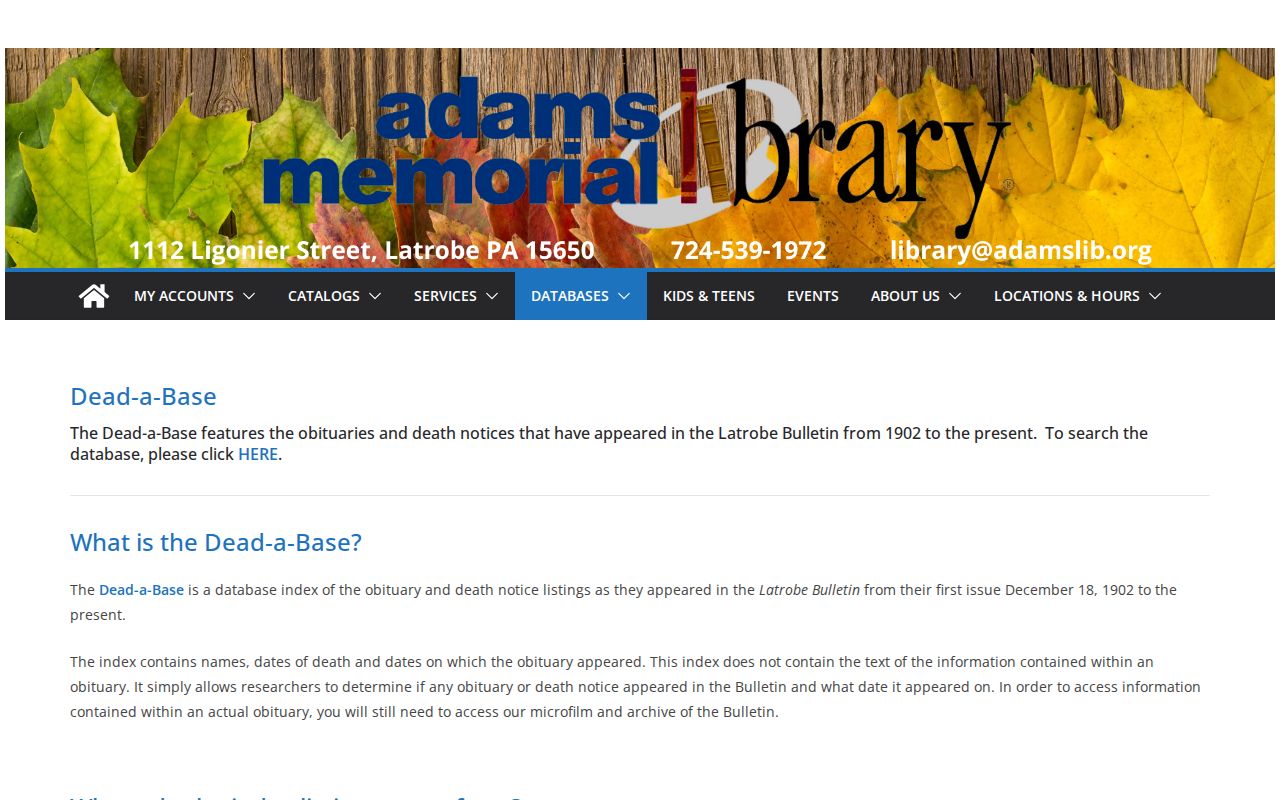
When a result has a name and notice date, the next evidence is the microfilm or archive copy, then an estate, cemetery, or family record that confirms the connection to Unity Township.
Unity Township City Directory Research Rooms
The regional shelf has several access paths. The Westmoreland Historical Society Pollins Memorial Library at Historic Hanna's Town offers more than 5,000 noncirculating books, genealogical records, and original local documents without an admission charge. Its written research requests cover people and families in the modern county boundary from 1773 forward. The archives are separate and appointment-based, preserving photographs, correspondence, minutes, unpublished papers, and rare publications.
The Pollins Memorial Library and genealogy service provides another Unity Township city directory research channel.
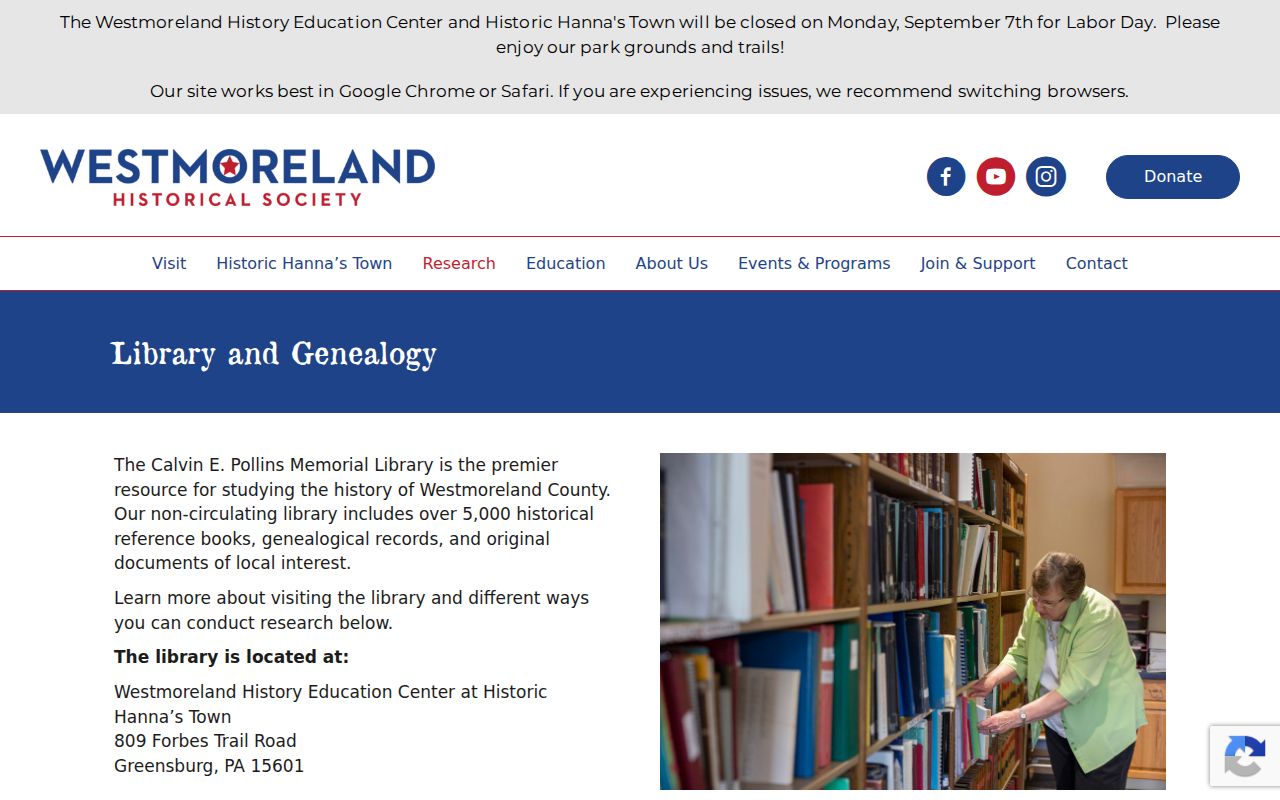
Its library materials can supply local histories and family records when the nearby directory books leave a gap.
The Westmoreland Historical Society Archives preserves appointment-based collections relevant to local historical context.
Archive material can add place and family context, but its existence does not establish a household address without a matching record.
Written research requests to the Historical Society cover persons and families in the modern county boundary from 1773 forward. The Society does not take those inquiries by phone. Its stated research fee is $30 for the first hour and $25 for each later whole hour, with a typical six-to-eight-week turnaround. That route is useful when a directory citation, cemetery clue, or deed reference needs local archival confirmation.
The State Library genealogy collection is a broader research route for Pennsylvania historical materials.
Use a statewide catalog as a roadmap, then confirm whether the item itself is online, at a library, or available only through a search-room request.
Unity Township City Directory Companions
When the nearby city directories have no usable entry, the Pennsylvania Room holds local materials that can narrow a household trail without inventing a directory record. Its listed titles include Della Reagan Fischer's Inscriptions of Unity Presbyterian Cemetery, Unity Township, Westmoreland County, Pennsylvania, 27 Cemeteries, Westmoreland County, and newspaper-derived marriage and death notices. It also holds church-record sets for Westmoreland County and nearby congregations. These sources can help identify a burial place, congregation, parent, married surname, or earlier locality.
Newspaper microfilm adds dated alternatives. GHAL lists the Greensburg Daily Tribune from February 8, 1889 through October 18, 1940, with noted gaps; the Greensburg Morning Review for 1908-1925 and 1940-1955; and the Greensburg Tribune Review from 1991 forward. A notice can reconcile an address, relative, estate, or cemetery clue, but the absence of a notice does not show that a household was absent.
For the era before nearby city directories, the 1857 Westmoreland County landowner map labels rural buildings, householder and owner names, land tracts, and a Greensburg landowner index. It is a pre-directory geographic lead. Match a labeled tract to deeds, tax or assessment material, church records, or census work before equating it with a modern Unity Township street address.